
eHRAF Learning Hub
Hunter-Gatherers in eHRAF
Hunter-gatherers — societies that depend primarily on hunting, fishing, and gathering wild foods — have been a central focus of anthropological research for over a century. eHRAF World Cultures contains ethnographic materials on hunter-gatherer societies. Use this hub to explore cultures, related OCM subjects, and curated learning resources.
(opens in new tab)“Returning from hunt (opens in new tab)” by Andreas Lederer, Wikimedia Commons, CC BY 2.0 (opens in new tab)Photo: Andreas Lederer (opens in new tab), CC BY 2.0 (opens in new tab)
Hunter-Gatherer Cultures in eHRAF
The following 0 cultures are classified as Hunter-Gatherers in eHRAF World Cultures, grouped by region.
No cultures found.
Where in the World
Geographic distribution of hunter-gatherer cultures in eHRAF World Cultures. Click a marker to view the culture profile.
Related OCM Subjects
These OCM (Outline of Cultural Materials) subjects are most relevant to the study of hunter-gatherer societies in eHRAF.
Search Examples
Here are some examples of how to conduct eHRAF searches.
Resources
- Explaining Human CultureExplaining Human Culture: Hunter-GatherersA comprehensive summary of cross-cultural research on hunter-gatherer societies from HRAF's Explaining Human Culture project.Learn more
- Teaching ResourcesTeaching WorkbookAn instructor workbook for teaching about hunter-gatherer societies using eHRAF World Cultures, suitable for undergraduate and graduate courses.Learn more
- Teaching ResourcesHRAF Advanced Cross-Cultural Research CourseAn open access resource disseminating materials from the HRAF Summer Institutes (2021–2023) on anthropological science, supported by the National Science Foundation.Learn more
- HRAF Homepage PostsWhy Hunter-Gatherers Have Fewer F and V SoundsHRAF research article exploring how subsistence strategy relates to phonological structure across hunter-gatherer cultures.Learn more
- HRAF Homepage PostsEvidence for Off-Site Fire Use by Hunter-GatherersAn exploration of archaeological evidence for fire use beyond campsites, drawn from the eHRAF Archaeology database.Learn more
- HRAF Homepage PostsA Cross-Cultural Perspective on ChildhoodHow childhood development and parenting practices vary across hunter-gatherer, pastoralist, and horticultural societies worldwide.Learn more
- Research DatabasesPlay Object Play (P|O|P)An open-access, user-driven database documenting toys and tools used by children in subsistence societies. It enables researchers to analyze how children’s interactions with material culture contribute to skill development and cultural learning, particularly within hunter-gatherer societies.Learn more
- Research DatabasesD-PLACEThe Database of Places, Language, Culture, and Environment brings together the dispersed corpus of information describing human cultural diversity, making it easy to contrast cultural practices and consider underlying factors.Learn more
Research Hypothesis Explorer
Select a hypothesis to learn more about the research in Explaining Human Culture.
Cross-Cultural Research Strategies
Suggested tips for conducting your own eHRAF World Cultures cross-cultural research project on hunter-gatherers.
How do I find out if eHRAF World Cultures contains information relevant to my main research topic?
Try Browse Subjects (opens in new tab) and enter a variety of seed words to find relevant subjects (or use the Subject box in Advanced Search) for your main area of interest. Read subject definitions and look for related subjects or broader or narrower categories. Alternatively, try keywords in Advanced Search (opens in new tab) and read some paragraphs in the results to see what subjects were used to index the paragraph. Filter to hunter-gatherers after a search. Do not expect to find information for all cases, but it is good to have information on at least 30 cases. See the tip below on finding information on other variables of interest.
What if I want to focus on a particular time period? How do you find which documents refer to which time frames?
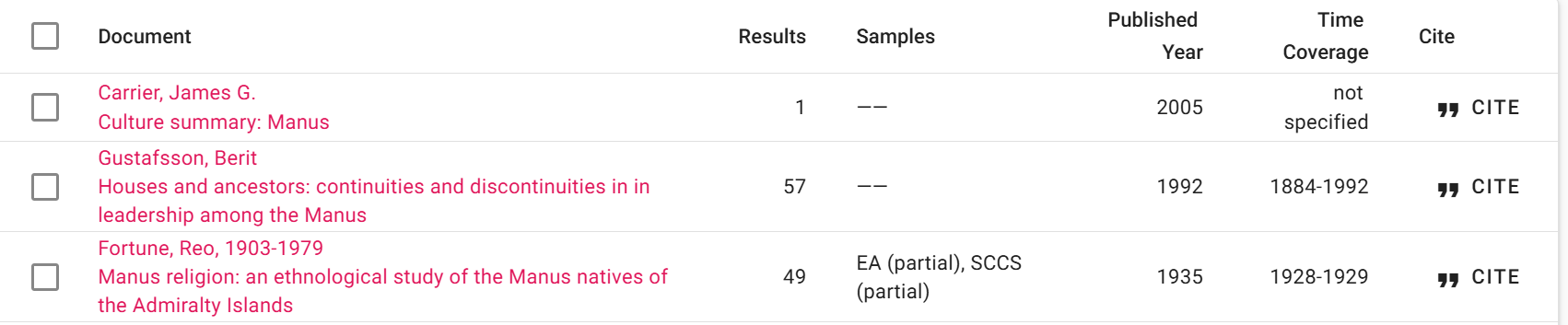
HRAF tries to put together culture collections that encompass multiple time frames and places. You should try to focus on a time frame most relevant to your research. For example, if you want to study traditional religious practices or traditional hunter-gatherer practices, you should aim for the earlier materials. There are two main ways to find information on time frames: a) when you look at culture results we display some information about the documents — in contrast to the publication date, time coverage conveys the time frame the information pertains to; b) use HRAF’s Cross-Cultural Concordance (opens in new tab), which not only matches time and place foci across samples, but also identifies documents in eHRAF World Cultures that are part of the same focus. To learn more about the HRAF Concordance, look for the appropriate video in the Coding section (opens in new tab) of the Advanced Cross-Cultural Course.
Do you want to limit yourself to cases that depend almost entirely on hunting, gathering, or fishing (86% or more classified as “hunter-gatherers,” by HRAF staff), or do you want to include cases identified as “primarily hunter-gatherers” (more than 56% dependence) as well?
There are two different filters under the subsistence heading for the two types of hunter-gatherer cases. You can use one or both of the filters, depending upon your research interests. We recommend looking at the two types separately before you decide to combine them. To show whether hunter-gatherers differ from other types of societies, you might also want to contrast hunter-gatherer societies with other types of societies.
How can I find previous cross-cultural studies on my topic of interest?
As a start, explore Explaining Human Culture (opens in new tab), which focuses on cross-cultural research on non-industrial societies.
Is eHRAF World Cultures as a whole considered a scientific sample?
No. eHRAF World Cultures grew somewhat opportunistically, so we recommend using a sub-sample such as the 186 Standard Cross-Cultural Sample cases; the 60 Probability Sample Files cases; the Simple Random Sample cases (about 28); or a combination. You can Filter to these samples after a search. See the Advanced Course section on Sampling (opens in new tab) to explore these different samples and how they might work for you. Note that it is usually not necessary to use all the cases in a sample; choosing a random sample of a larger sample is often acceptable.
How can I find previously coded information from other researchers?
D-PLACE.org (opens in new tab) has compiled a lot of coded variables from different cross-cultural samples. To minimize measurement error, you should match the time and place foci for the variables you plan to code. eHRAF World Cultures provides document matches to two main samples with coded variables. To find these document matches use the Filter “Document Level Sample.” The sample with the largest number of coded variables (over 2,000) is the 186 case Standard Cross-Cultural Sample (SCCS). Most of the 60 Probability Samples Files (PSF) are included in the Ethnographic Atlas (EA) which has a substantial number of coded variables.
To learn more, look at the video in the Coding section (opens in new tab) of the Advanced Cross-Cultural Course on D-PLACE.org (opens in new tab).
If there is information in eHRAF World Cultures on my central area of interest, how do I find whether or not there is information on other variables of interest?
Remember that eHRAF World Cultures searches by paragraph. Rarely will all the variables of interest to you appear in the same paragraph. Your main topic of interest should always be looked for first because whether or not there is enough information will limit your search strategy. We recommend measuring each variable or closely related sets of variables in separate searches.
How do I develop measures and coding rules more formally after ascertaining that the needed information is available in eHRAF World Cultures?
The measurement process is almost always iterative because you need to take care to develop measures that match the kind of information found in ethnographies. If possible, you want to try to employ higher forms of measurement (ordinal or interval measures), but more precision is not desirable if the data for such precision are not available. Also, you need to assess if coders understand and can code reliably using the coding instructions you develop. See the Advanced Course videos on Measurement (opens in new tab), Minimizing Errors in Measurement (opens in new tab), and Coding (opens in new tab).
I’m new to navigating eHRAF World Cultures. Where can I find tutorial videos?
A playlist of tutorial videos (opens in new tab) can be found on the HRAF YouTube channel.